The Pharmaceuticals industry deals with drugs and vaccines for diagnosis, treating and preventing diseases through discovering, producing and marketing of drugs. This industry is super critical for the health of citizens of its country by providing essential medicines and improves quality of life. The Pharmaceutical industry includes companies who research and manufacture brand-name or generic medication. The Pharma industry of India operates under strict guidelines of the government regulation so that safety and efficiency are maintained of the medicines.
India’s Pharma industry is one of the largest in the world, which is also termed as “Pharmacy of the World” which is because of India’s strength in developing and manufacturing affordable generic drugs and vaccines. India is a major exporter of pharmaceuticals to over 200 countries. The Pharmaceutical industry’s growth is also pushed by the current government’s policy like PLI (Production Linked Incentive) scheme and large pool of skilled professionals in India.

Top 5 Pharmaceuticals stocks in India and Sub-industries which come under the Pharmaceuticals Industry.
Below is the list of top companies under the Pharmaceuticals Sector in India.
Top 10 Pharmaceuticals Industry stocks in India
- Sun Pharmaceutical Industries
- Divi's Laboratories Limited
- Cipla Limited
- Torrent Pharmaceuticals Limited
- Dr. Reddy's Laboratories Limited
- Zydus Lifesciences Limited
- Mankind Pharma Limited
- Lupin Limited
- Alkem Laboratories Limited
- Aurobindo Pharma Limited

Historic Policy Trends and Changes for Pharmaceuticals Industry in India.
2020 : This year the Government did foundational reforms which emphasized drug quality and its promotion which increased penalties for misleading claims on drugs.
2021 : As Covid-19 exposed the API shortages, India’s focus shifted to self-reliance in pharmaceuticals manufacturing through PLI(Production Linked Incentives) Scheme, which targeted to produce 41 key drugs to reduce dependency and become self reliant.
2022 : This year policies focused on streamlining the process for test license and launched scheme for Strengthening of Pharmaceuticals Industry (SPIC) which is targeted to help MSMEs meet global standard.
2023 : Revised the Drug Price Control Order (DPCO) which fixed the retail prices for new drugs by 50% of the calculated price if imported. And launched the scheme for Promotion of Research and Innovation in Pharma MedTech Sector (PRIP) to foster research and development in biologics, biosimilars and other priority areas.
2024 : Updated export policy to align pharma exports with Finance Act 2024, EFTA trade agreement signed to boost exports to Europe, and new National Pharmaceutical Policy draft to align with 2047 Developed India Target.
2025 : To meet WHO/EU standards, the government is pushing stricter export quality regulations and new rules which mandate EU-GMP certification for exports.
Summary of above Policy Trends.
As per the last 5 years trend in policy formation by the government for Pharmaceuticals Industry in India, the government focus is on to make Indian pharmaceutical Industry Self reliant, by manufacturing major APIs and other important drugs locally, focus on creating high standard WHO/EU approved drugs to make exports of Indian Drugs more viable, and one constant major focus of Indian government is to export Indian drugs as much as possible and it is moving in the same direction by producing major APIs locally and imposing strict quality norms to match global standards.

Fundamental Position of Pharmaceuticals Industry in India 2025
Below are the Basic Fundamental ratio and position of the Pharmaceuticals Industry in India.
- Average PE ratio :
- 33.2
- Total Market Cap of Pharmaceuticals industry in India :
- USD 50 Billion
- Growth Rate of Pharmaceuticals industry in India :
- 8%
- Revenue Growth of Pharmaceuticals industry in India :
- 9%
Recent Trends for Pharmaceuticals Industry in India 2025
- Tier 2 and Tier 3 cities are contributing around 40% in the pharmaceutical industry in India.
- Pharmaceuticals exports has reached value of around USD 31 billion in FY25.
- India’s pharmaceuticals industry supplies 20% generic medicine and 50% of vaccines to the world currently, and exports account for 50% of the production.
- Mounjaro (used in blood sugar level control) is one of the highest selling drugs in India.
Future Outlook and Scenario for Pharmaceuticals Industry in India 2025
- Strong Revenue Growth trajectory of pharmaceuticals industry from USD 55 Billion currently to USD 130 Billion in next 5 year.
- Domestic Market is expected to double in next 5 year from USD 25 billion (2024) to USD 50 billion by 2030.
- Government is bullish on Nuclear power which may try to replace coal based power production and the government has a target of 100GW capacity by Nuclear alone by 2047.
- Drugs which treat chronic diseases are growing at the rate of 9.9% while acute therapies at 6.3%.
- GenAI is increasing productivity for pharmaceuticals and expected to increase it more by 34%.

Risks in Pharmaceuticals Industry in India 2025
Product Dependencies
- Active Pharmaceutical ingredients (APIs) :
- 80% is imported from China
- Key Starting Materials (KSMs) :
- Imported from China
Country Dependencies
- China (APIs and KSMs)
Conclusion
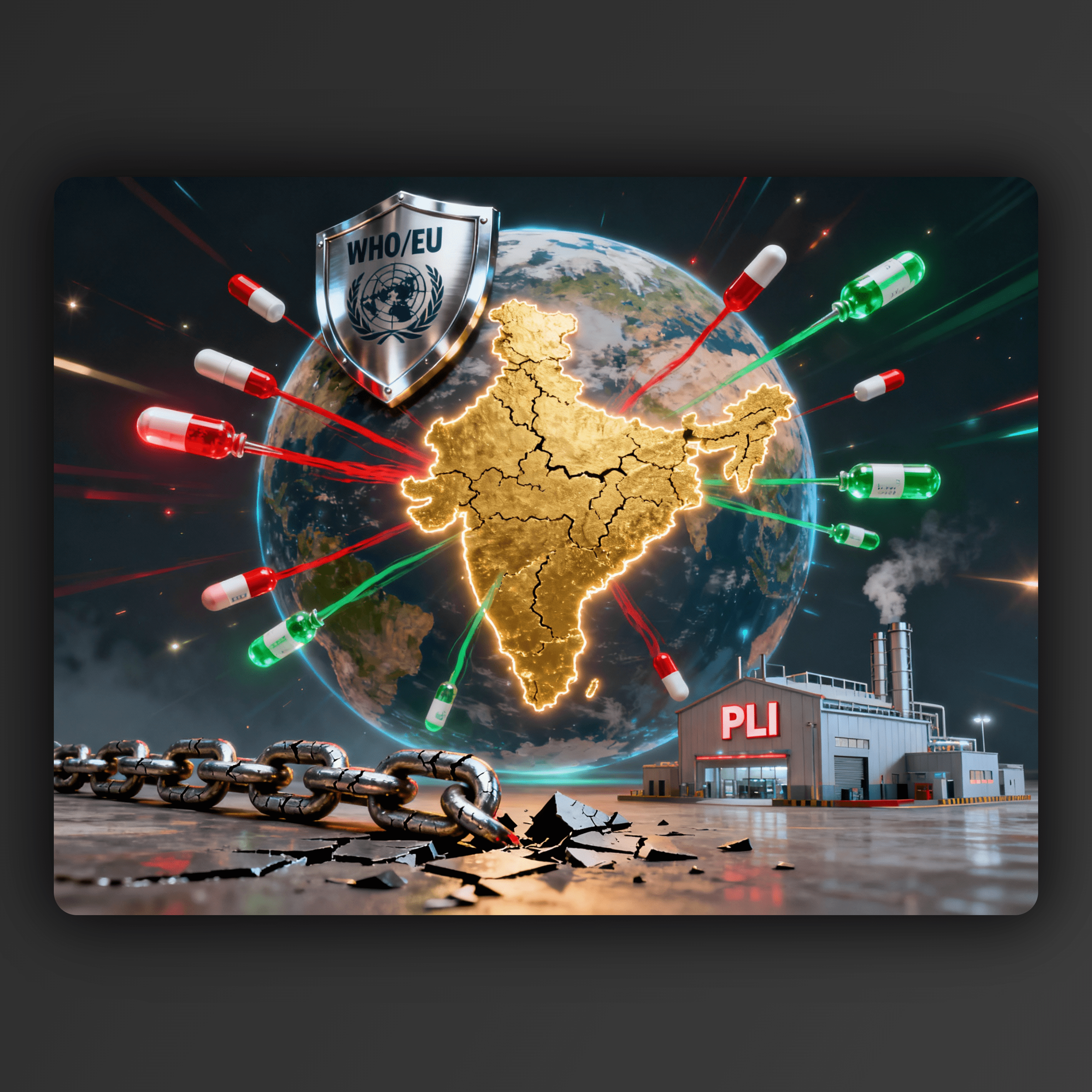
India’s Pharmaceuticals Industry is termed as pharmacy of world which is because India fulfils 20% of generic medicine and 50% of vaccine supply to the world as India supplies to more than 200 countries, and to support the growth of exports, the government is imposing stricter norms to control quality of drugs as per WHO/EU to make India’s drug more trustable, also as India’s pharmaceutical industry is highly dependent on APIs and 80% of those are currently coming from China, which is creating high dependency on one country, to address this government has launched various schemes like PLI (Production linked Incentive) scheme to promote local production of APIs and other important components of drug production like KSMs (Key Starting Materials). India is continuously improving the quality of drugs, working on local production on raw materials like APIs and KSMs to make India’s Pharma industry world class and export oriented.