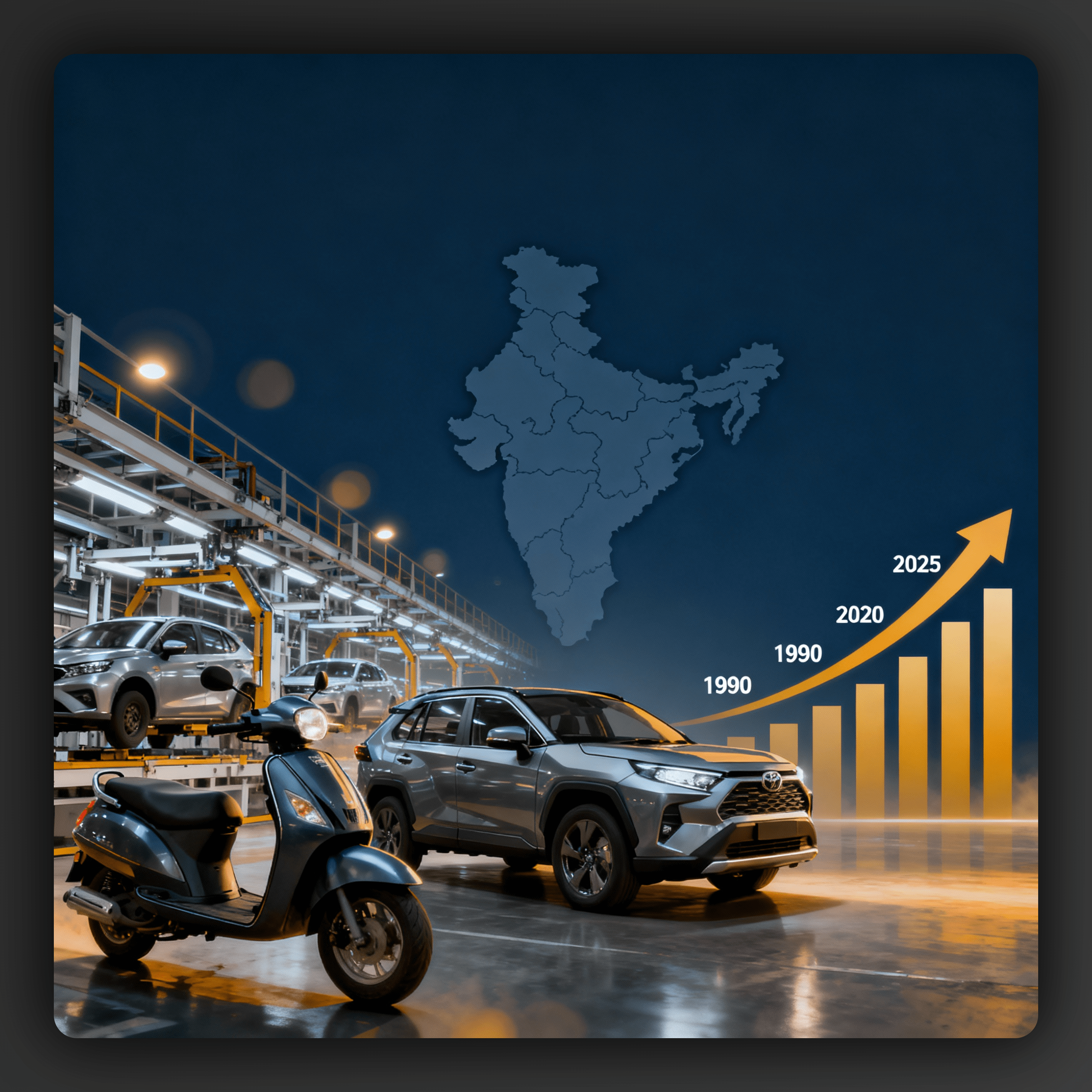
The Automobile Sector of India contributes around 6% of GDP, it has grown from 2 million unit production in 1990 to 28 million units in 2024, in 2025 India has produced around 31 million units across passenger vehicles.
India is the largest producer of two-wheelers around the world and top 4 in car manufacturers. Below is the complete analysis of how the Automobile industry and their sub-industry are performing with insight of top players among them.
Top 5 Automobiles & Components stocks in India and Sub-industries which come under Automobiles & Components.
Below are the list of top stocks under Automobiles & Components industry in India and top stocks for its sub-industries.
Sub-industries which comes under Automobiles & Components
- Automobile Manufacturers
- Motorcycle Manufacturers
- Auto Parts & Equipment
- Tires & Rubber
Top 5 Automobiles stocks in India
- Maruti Suzuki India Limited
- Mahindra & Mahindra Limited
- Bajaj Auto Limited
- Eicher Motors Limited
- TVS Motor Company Limited
Top 5 Automobile Manufacturers stocks in India
- Maruti Suzuki India Limited
- Mahindra & Mahindra Limited
- Tata Motors Limited
- Force Motors Limited
- ASK AUTOMOTIVE LIMITED
Top 5 Motorcycle Manufacturers stocks in India
- Bajaj Auto Limited
- Eicher Motors Limited
- TVS Motor Company Limited
- Hero MotoCorp Limited
- OLA ELECTRIC
Top 5 Auto Parts & Equipment stocks in India
- Samvardhana Motherson International Limited
- Bosch Limited
- Uno Minda Limited
- Bharat Forge Limited
- Schaeffler India Limited
Top 5 Tires & Rubber stocks in India
- MRF Limited
- Balkrishna Industries Limited
- Apollo Tyres Limited
- CEAT Limited
- JK Tyre & Industries Limited
Historic Policy Trends and Changes for Automobiles & Components Industry.
2020 : Transition to stricter and robust emission norms which included , BSVI emission norms, Scrappage Policy, Incentivising local production.
2021 : Policies Focused on self-reliant manufacturing eco-system by increasing custom duty and introduction of Production-Linked Incentive (PLI) Scheme.
2022 : Implementation of PLI Scheme to boost local Production and support the EV supply chain.
2023 : Government kept on supporting electric mobility, with the FAME (Faster Adoption and Manufacturing of Hybrid and EVs) scheme to incentivise the adoption of hybrid and EVs.
2024 : Major updates in Industry standards regulation with introduction to IATF 16949 rules for quality management system.
2025 : Union Budget 2025 pushed for electric vehicle manufacturing by removing import duty on 35 key EV major battery components.
Summary of above Policy Trends.
Government’s clear vision is to transform mobility to sustainable, self reliant and environment friendly industry, by putting stricter rules for emission, giving incentives for local production and specially to EVs, by this we can expect more upcoming stricter laws for emission, which will be an issue to company producing internal combustion engine vehicles and EV manufacturer and EV components manufacturer will get more and more incentives.
Fundamental Position of Automobiles industry in India 2025
Overall Automobiles & Components industry
- Average PE ratio :
- 33.8
- Total Market Cap of Automobiles & Components industry in India :
- $131.3 billion or ₹ 10.9 trillion
- Growth Rate of Automobiles & Components industry in India :
- 11.3%
- Revenue Growth of Automobiles & Components industry in India :
- 8-10%
Automobile Manufacturers
- Average PE ratio :
- 52.91
- Total Market Cap of Automobile Manufacturers in India :
- ~$60-80 billion
- Growth Rate of Automobile Manufacturers in India :
- 5.6-6.2%
- Revenue Growth of Automobile Manufacturers in India :
- 7.3%
Motorcycle Manufacturers
- Average PE ratio :
- 41.15
- Total Market Cap of Motorcycle Manufacturers in India :
- ~$66-72 billion
- Growth Rate of Motorcycle Manufacturers in India :
- 10.50%
- Revenue Growth of Motorcycle Manufacturers in India :
- 6-8%
Auto Parts & Equipment
- Average PE ratio :
- 17.79
- Total Market Cap of Auto Parts & Equipment in India :
- ~$30-35 billion
- Growth Rate of Auto Parts & Equipment in India :
- 5.75%
- Revenue Growth of Auto Parts & Equipment in India :
- 9.6%
Tires & Rubber
- Average PE ratio :
- 40.40
- Total Market Cap of Tires & Rubber industry in India :
- $18-20 billion
- Growth Rate of Tires & Rubber industry in India :
- 6.5-7.0%
- Revenue Growth of Tires & Rubber industry in India :
- 8-10%
Recent Trends for Automobiles industry in India 2025
- 26 Million Vehicles get registered in 2025 in India out of which 1.96 million were EVs.
- EV Cars sales got increased by 52% in FY25 in India.
- Two wheeler market got declined by 3.4% in FY25 in India.
- EV components saw huge demand and grew by 9.6% in India.
Future Outlook and Scenario for Automobiles industry in India 2025
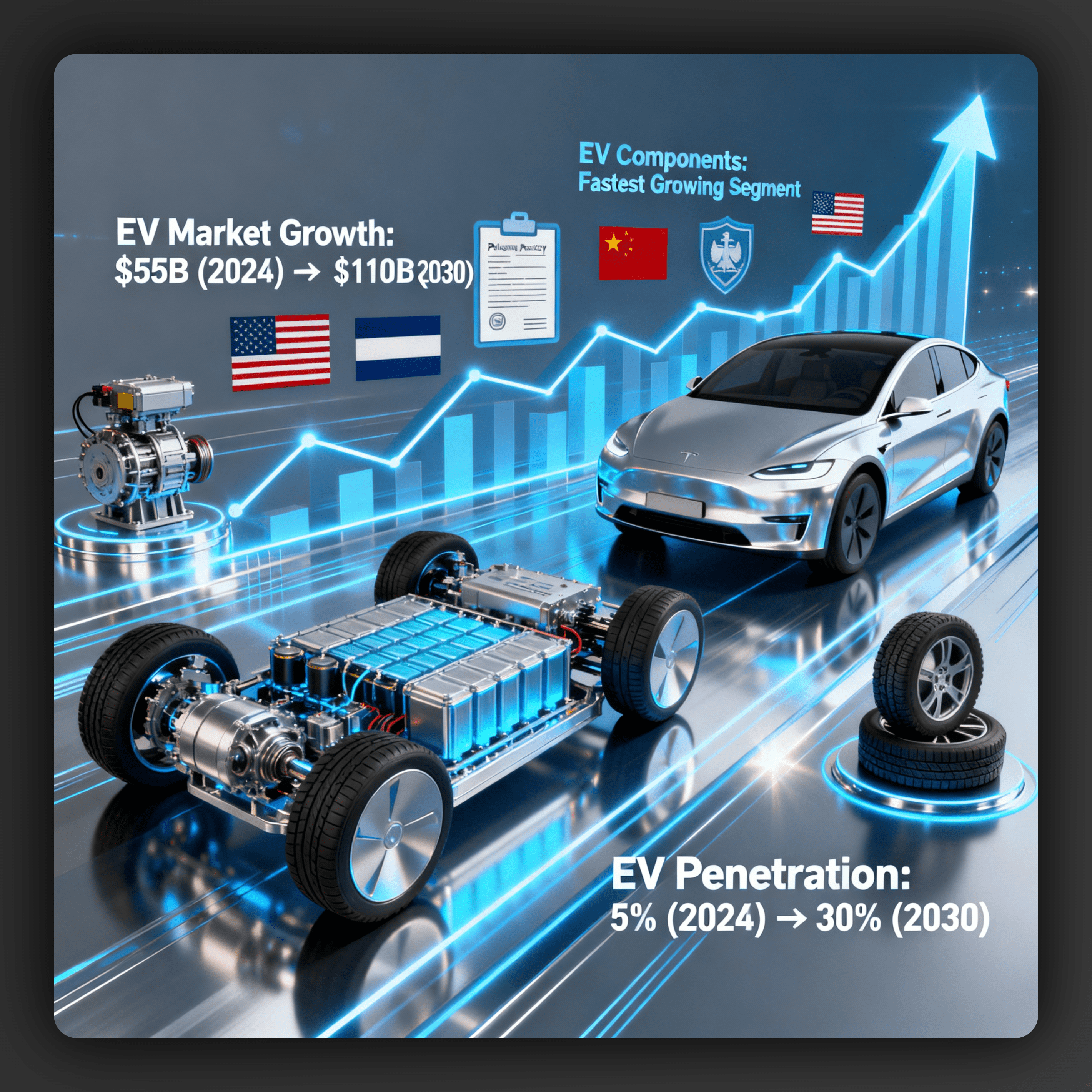
- With the push of government and policies EV market may get double in next 5 years from 55 Billion USD to 110 Billion USD.
- EV Components is the fastest growing segment among all in the Automobiles industry and is expected to grow further.
- EV Penetration may reach 30% by 2030 from 5% in 2024.
- Tire and rubber Market is projected to grow at steady 8-10% regardless of industry transforming to EV from internal combustion engines.
Risks in Automobiles industry in India 2025
Product Dependencies
- Lithium Batteries
- Rare Earth magnets
- Semiconductor
- Crude Oil
Country Dependencies
- China (Battery, electronics, semiconductors, microprocessor)
- Japan (Engines and Semiconductor)
Government Intervention Risks
- EV Subsidy Withdrawal Risk
- Possible GST hike on ICE vehicles
- BS-VII emission norms complication and compliance cost
- Without Subsidy EV sales would drop by 40%
- New emission norms would require 10-15% R&D Spend

Conclusion
Automobiles Industry is a promising industry with high market cap and huge contribution to National GDP, and high projected growth but with government push for sustainable and greener mobility alternative, industry is transforming from ICE to EVs and government is imposing stricter emission norms which are forcing companies to spend extra 10-20% in R&D for the same. Looking at numbers and growth percentage EVs looks promising but it comes with its own risks, as it is highly depended on China for all major components including batteries and semiconductor also EV sales are highly depended on government subsidies and low GST which makes this industry very fragile as it is transitioning to a segment which is highly depended on multiple factors, which includes high dependencies on China which India already have high tension in the past and government schemes and policy may change every 5 year if government is changed which makes this transitioning sector fragile. But sub-industry like Auto Parts & Equipment and Tires & Rubber would not be affected much by the above which makes them a safe bet among the others in the industry.