This quick IPO test includes a practical checklist for everyday investors to evaluate any IPO systematically. It highlights the need to understand the nature of business operations in short, knowing why the company is raising funds, and checking future sustainability. It also emphasises comparing valuation with peers and assessing business scalability based on various metrics.
Retail investors are guided to review long-term investors and promoter holdings, evaluate favourable conditions within the industry, focusing on vital risk factors, and considering expert opinions. The checklist concludes with highlighting the importance of a quick news scan and checking the overall market sentiments to avoid last-minute surprises. This data-led guide is what every investor needs now to spot the strong offer.

India’s primary market is witnessing a robust growth like never before. A total of INR 90,000 Cr has been raised through IPOs in the past 90 days. The National Stock Exchange (NSE), being the 5th largest stock exchange in the world, provides a credit platform for companies that decide to go public. In such a booming market, where companies are raising capital from the public almost every week, an everyday investor may struggle with a dilemma like ‘Is this IPO worth applying for?’. IPO analysis may feel overwhelming with time constraints, hype and noise on social media
With many new generation companies, the year 2026 has some of the big names like Jio platforms, Flipkart, NSE, Phonepe and SBI Mutual Funds to the IPO checklist. Here is a guide that can help every retail investor to quickly analyse any IPO, filter out the noise and make a rational decision. A rapid IPO test in this guide includes a practical checklist for no-nonsense analysis of any IPO to spot the right opportunities.
A Practical Checklist for Quick IPO Analysis
Here is a structured, data-led checklist that is useful for every retail investor to quickly judge an IPO and spot the strong offers.
Understand the nature of business in one sentence
While analysing an IPO, the first question to ask yourself is – ‘Can I summarise the business and its operation in one sentence?’. If the answer is ‘no’, you must spend more time understanding the business or skip the IPO. In a short analysis window, the complexity of business operations is usually a ‘warning bell’ as it is important to know what you are investing in.
Let’s take the recent ‘Groww’ IPO. If you can summarise the business model as – ‘ A number one online investment platform that provides commission-free and simple ways to invest for retail investors in various financial instruments like mutual funds, stocks and many.’
Know why the company is raising money
Knowing the purpose of IPO is vital, and it is generally stated in the DRHP(Draft Red Herring Prospectus) filed with the SEBI (Securities and Exchange Board of India). The three main purposes included in the DRHP are:
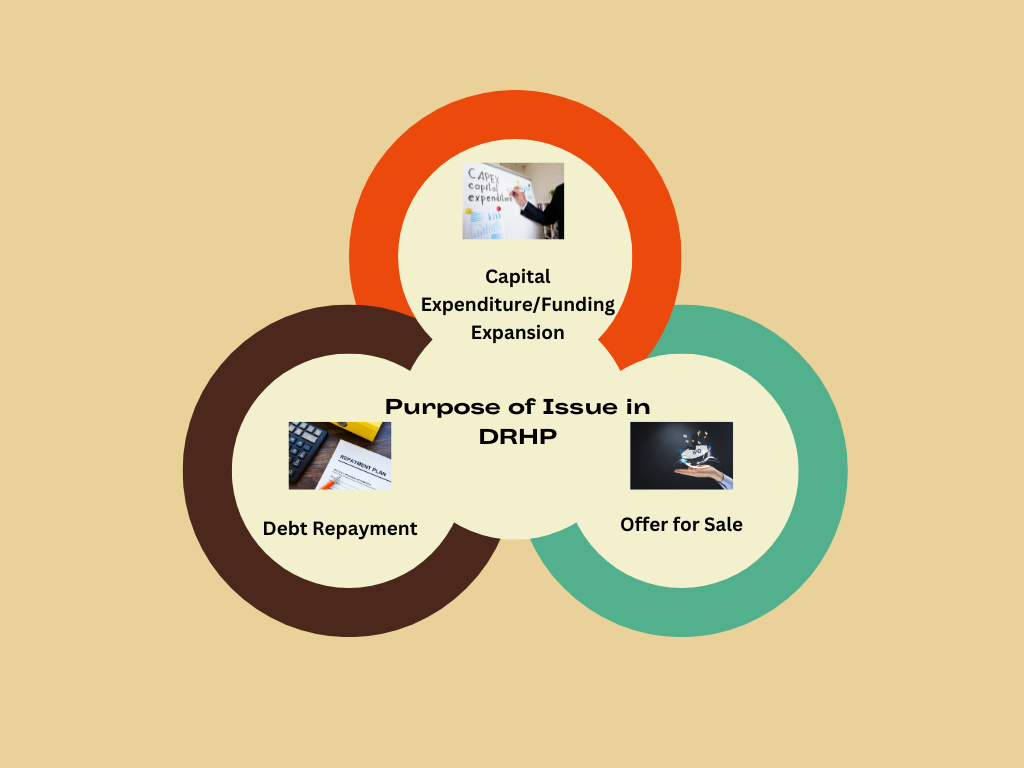
- Capital expenditure or funding expansion is generally positive, as it is done for long-term growth, expansion, and to increase efficiency.
- Debt repayment can give a slightly positive or neutral outlook as the focus is on improving financial health and reducing interest burden.
- An offer for sale (OFS) usually requires more scrutiny, as sometimes early investors or promoters would be cashing out, which can signal a concern for new investors about the company’s future. However, it is not always a red flag. The recent LG Electronics India IPO is an example of OFS.
Check revenue growth against cash flow to gauge sustainability
Many digital-first businesses with strong revenue growth often fail due to running out of cash. Hence, it is important to check revenue growth against the cash flow of the business while analysing an IPO. Here are two main things to check:
- Check consistency in revenue growth by looking at the CAGR (compounded annual growth rate) pattern for the last three to five years. Consistent growth indicates a strong footing and sustainability of the business.
- Check operating cash flows; negative cash flows can be a ‘red flag’.
Comparison of valuation
Compare the valuation of the business with that of its listed peers. You can use any method, like revenue multiples or price-to-sales (P/S ratio). Get answers to a few important questions, like- is the IPO valuation higher than that of the industry average? Is the premium and profitability justified?
For example, Lenskart’s P/S ratio was significantly higher than that of its peers like Titan. However, the profitability and premium are justified due to its distinct tech-enabled business model, scalability and its superior growth rate.
Review customer acquisition and contribution margin
If the business is consumer-tech or is on subscription models, it is important to review its customer acquisition cost and contribution margin. Comparing customer lifetime value with customer acquisition cost (CLV to CAC ratio) and contribution margin helps you understand the business’s scalability and overall financial health.
Check on promoter holdings and investors
You can assess the credibility of the business by checking on promoter holdings and long-term investors. For example, a sharp decline in promoter holding during an IPO (with offer for sale as a purpose) requires scrutiny. Long-term participation of institutional participants like pension funds gives confidence.
Analyse the industry and market catalysts
Take a look at the overall market-specific trends and macroeconomic factors. Industry story is also an important consideration to analyse an IPO. How the industry is growing, how customers are adapting to the business model, and how favourable are regulations governing the industry are. If we consider Groww as an example, digital investment platforms are growing rapidly with technology adoption, with favourable regulations in India.
Consider unavoidable risks
Every IPO has its own risk. Some of the common risks are unavoidable and need to be considered while analysing every IPO. Some risks are sector or business-specific. For example, cash flow problems or high marketing burns are quite common in consumer tech businesses. Regulatory risks can be considered for lending and fintech businesses. Inventory management risks are quite common in retail-led businesses like Lenskart.
Read an expert opinion
Despite online noise, expert opinion is important. Pick any one expert opinion, such as the views of a financial journalist or a brokerage report. Compare your checklist (positives and negatives) with their opinion. You can do more research based on this comparison.
A quick scan through the news and market sentiments
Quickly sweep through the latest news regarding the business, such as the latest company updates, industry disruptions, management changes and market sentiments.
Important Tip: Use Labhtark’s market screener to view the latest stock market news and financial updates before you apply for any IPO.
Conclusion
To conclude, this quick practical checklist can confidently clear your dilemma of - is this IPO worth applying for? Should I invest or pass? This guide is data-led and not prediction-based. Focus on the business’s nature, strong fundamentals, financials and growth potential, along with industry and broad market sentiments, can help you better understand and invest in the right opportunity.