A successful long-term equity portfolio requires a data-backed, disciplined approach, not based on guesswork. Many studies have shown that systematic screening, periodic review, and rebalancing can generate significantly higher returns than the intuition-based approach. In an environment crowded with thousands of listed stocks from different sectors, AI-powered smart screeners are no longer optional, but an essential tool for filtering quality opportunities efficiently, as suitable for your investing ‘template’.
This guide outlines a step-by-step approach to using advanced screeners: setting a clear investment framework, filtering stocks systematically, maintaining proper portfolio allocation, and reviewing and rebalancing regularly. When used consistently, smart screeners help you stay disciplined, reduce behavioural errors, and build resilient portfolios capable of creating wealth across market cycles.

Building a successful long-term equity portfolio needs a rule-based, systematic and disciplined approach, not guesswork or intuition. The Morning Star’s ‘Mind the Gap’ study highlights how a disciplined investor with systematic screening and rebalancing strategies can increase portfolio return by nearly 1.7% yearly than the average investor. That means data-backed screening can be a great guide for long-term investments.
Today, screeners have become even more crucial as India has over 5,500 listed companies. Choosing the right stock seems impossible and challenging without a screener. Especially, smart screeners powered by artificial intelligence play a vital role in helping the investor to filter the right investment opportunities, cutting through the clutter in no time.
This step-by-step guide aims to break down how you can choose the right stocks and build a resilient portfolio for the long term by effectively using the smart screener. Before we get into the steps, let us understand why smart screeners are crucial for long-term investing.
Why Smart Screeners are Crucial for Long-Term Portfolio Building?
Advanced screeners today use AI-driven insights, financial metrics and real-time market data to narrow down stocks and shortlist the right ones as per your goal and need. Here are some key reasons as to why smart screeners matter for long-term portfolio building:
- You can filter the right stocks in no time and customise the filter to fit your needs.
- Smart screeners are completely data-based, eliminating the guesswork.
- Screeners help you align with your investing strategy – growth or stability, or a combination of both, etc.
- Screeners help you manage risk efficiently as you can filter out volatile stocks, companies with a poor track record or high-debt businesses.
How to Use Smart Screeners for a Long-Term Portfolio?
Start with clear goals and an investment framework
Setting goals is a crucial step for success. Many studies suggest that investors with clear investment goals have a much higher success rate. Before you hit any screener, be clear with your financial goals, risk profile and time frame. For example, you may be investing with an aggressive approach for your retirement, which is twenty years away, or you may be investing with a balanced approach for your child’s higher education.
Depending on your investment framework, your portfolio can vary (growth/stability/value/mix). If you are investing for multiple goals with different time horizons, you need to pick the right stocks that have the right combination and balance accordingly. When you have the clarity, smart screeners can do the heavy lifting.
Use smart screeners to filter the right stocks
Advanced screeners let you filter stocks on various parameters and according to your investment framework. You can filter them based on:
- Technical indicators
- Financial ratios (ROE, PE ratio, and debt-to-equity ratio, etc.)
- Fundamentals
- Dividend history
- Company’s financial health, etc.
For example, let us say you are looking to build a ‘growth quality portfolio’ for the long-term. Then you would apply the following filters to understand the efficiency of management, profitability and growth potential of the business and to ensure low leverage risk and consistency in business expansion.
- Return on Equity > 12 to15%
- Debt-to-Equity Ratio > 1
- 5-year Profit CAGR > 12%
- 5-year Sales CAGR > 10%
- Operating cash flow -positive
- Strong promoter holdings, etc.
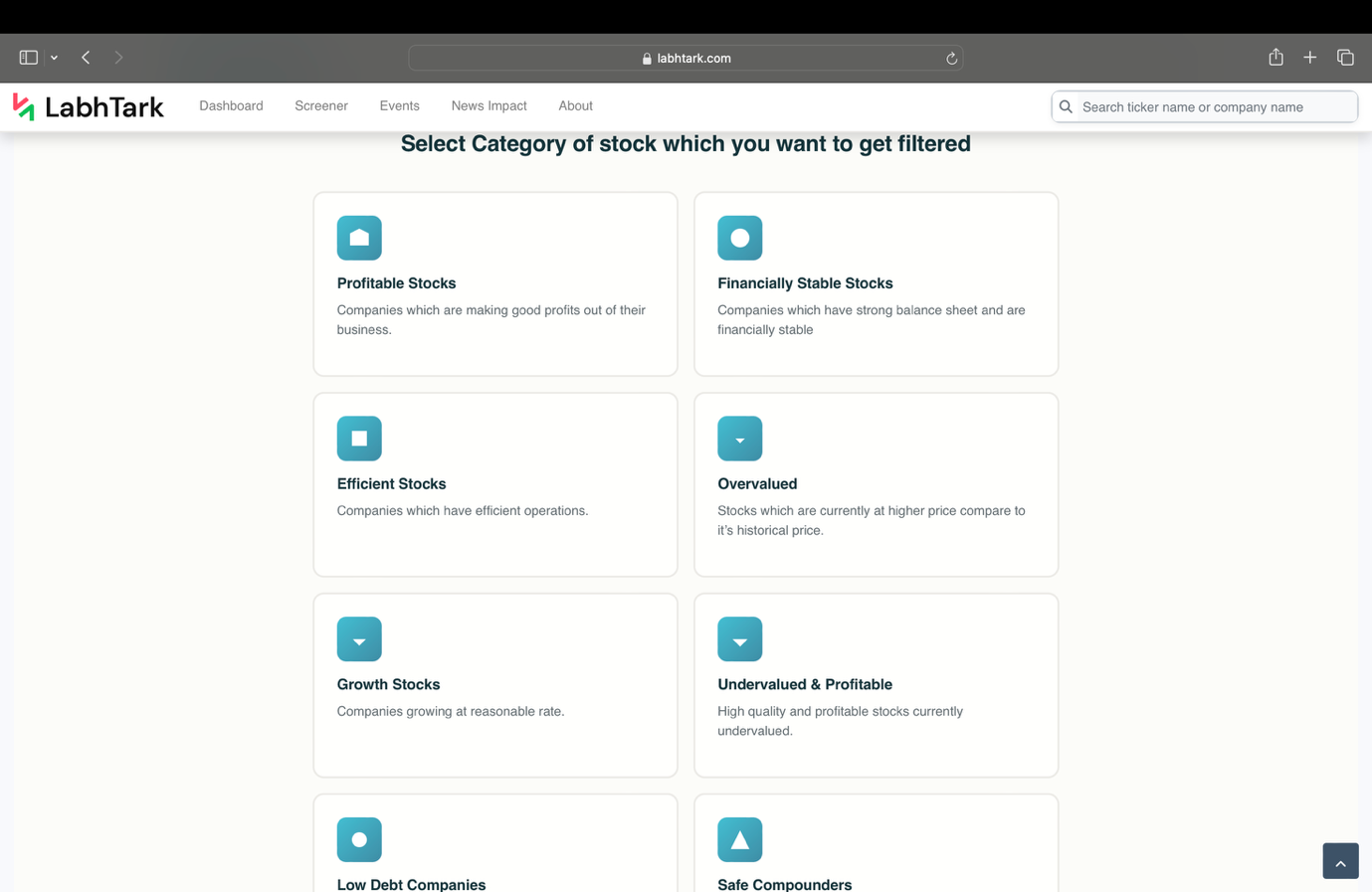
Important Tip: Use Labhtark’s smart screener to filter the right stocks based on your investment framework while building your long-term portfolio. You can use the advanced filter to make the stock selection as per your portfolio template (growth/quality/dividend/stability/mix).
If you are new to Screener, then you can use Labhtark’s AI-powered quick screener to filter the right stocks in 60 seconds. You can use it for both short-term or long-term investments. Filter them based on various categories, market segments, indices, sectors, sub-sectors and more.
Ensure the right allocation
Once you pick the right stocks suitable for your investing strategy, decide the right allocation suitable for your goal and risk profile. For example, if you are building a long-term portfolio, you may choose to build a portfolio with 60% growth stock + 30% dividend stock (for stability) and 10% in safety bets.
Review and rebalance your portfolio regularly
Rebalancing your portfolio periodically enhances returns more than that of the ones who don’t rebalance. Hence, ensure to review and rebalance your portfolio regularly.
Using screeners is not a one-time exercise. Hence, ensure to review and screen stocks for newer opportunities and rebalance your portfolio regularly. If there are any allocation drifts, bring them back to the desired level.
Conclusion
To conclude, smart screeners are bridging the gap by helping today’s investors to focus on the right stock pick by cutting through the noise. You can focus on what truly matters for you – consistency, discipline, quality and risk management. A structured and evidence-backed approach is the key to long-term wealth creation. AI-powered screeners offer you the confidence and clarity to build that evidence-backed long-term portfolio that can thrive in any market environment.